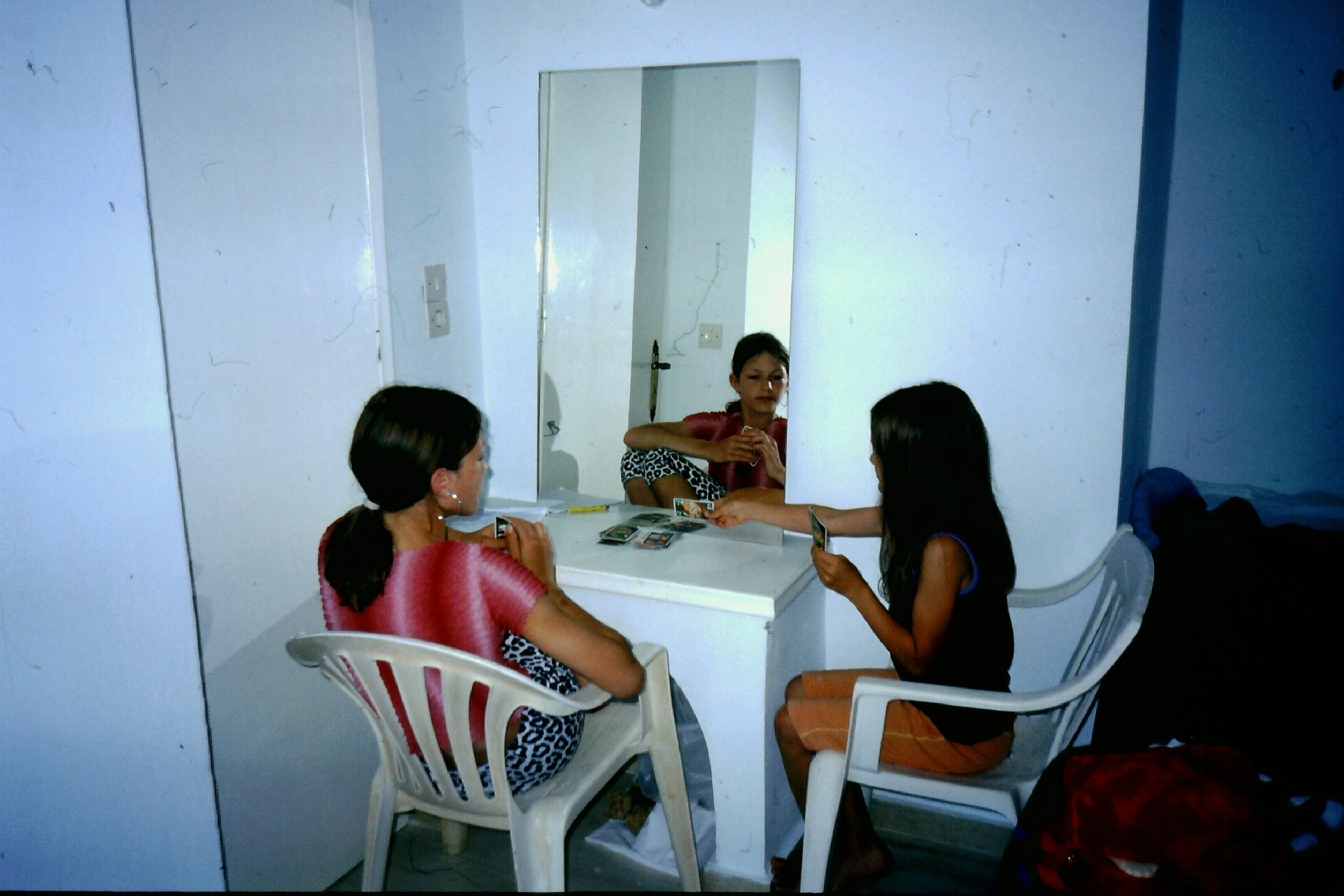
Playing cards with my sister, summer 2003
I made it. After scheduling my account for deletion and not logging in for thirty days, my private Instagram profile will be permanently deleted today. I made the decision haphazardly the night before my recent move, but the urge to do something had been a long time coming.
It might not be too obvious for anyone joining me from my YouTube channel but I was actually strongly opposed to smart phones for the longest time. When I was still in Heidelberg, pretending to take my Bachelor’s seriously (while already spending way more time freelancing and doing other things), I noticed from 2011 onwards how people were consumed by early iPhones (and pathetic early Android copycat attempts) more and more. I was used to bringing my reading material on the train, whether it was Academic or bricks for a novel, and increasingly, I became the only one doing so. I refused to see the point of bringing the internet with me and instead relied on SMS for as long as possible. Eventually, in 2015, I gave in and took over someone’s discarded old Samsung. I signed up for WhatsApp and eventually Instagram.
Ten years down the line and the relationship with my device, now much more up to date and much more expensive, is still heavily ambivalent. It would be ridiculously hard to completely ditch it and all attempts I’ve watched being documented on YouTube (and I’ve watched at least a dozen) eventually resulted in it being an experiment rather than a permanent lifestyle choice. My public transport subscription is on my phone, my business bank account operates almost exclusively through mobile, so does my trading app, my extensive collection of lists that help my everyday not to fall apart, etc. I could find alternatives somehow. But would I, really, in this day and age?
The problem, however, is obviously a different one. None of us is addicted to their Deutsche Bahn app. (I guess.) If this was a lock-and-key situation, we would pull out our phones for specific purposes and then put it away again. I’m not flashing my key at people all day, but our data-mining smart devices in the palm of our hands have somehow landed that privilege, accompanying us to family dinners, to our bedrooms when we cry about our break ups and to the restroom in a hotel after we ate something bad. Not even our partners or best friends see so much of us every day.
Is that a problem, in and of itself? No. The problem I began seeing for myself, as do so many other people, is the way we choose to interact with it. That is, we don’t even choose. If this was a functional relationship, there would be a clear distinction between situations where we want to use the object and situations where we don’t - because it has no purpose there. But that’s not the case anymore and the reason for that is not your mobile payment function or your video call app, it’s large-scale dissociation addiction.
I might have talked about dissociation before in passing. It’s a psychological phenomenon that occurs in more serious as well as in benign settings. Dissociation can be the body’s way of escaping an unbearably painful situation and it can also simply be the state in which we are when we stroll along our usual route for the umptieth time and think about meal plans instead of consciously experiencing the walk. The mind wanders someplace else and what’s in front of us still gets processed to a degree but doesn’t necessarily reach consciousness to the same level. Contrary to psychosis, reality is not experienced incorrectly, simply detached.
I have experienced various forms of dissociation throughout my life, ranging from daydreaming to the more intense variations that come with cPTSD. Some are very unpleasant, like the ones I experience during an anxiety or panic attack. The world seems to fall into chaos and disarray and while I can acknowledge that everything is still there just like it was a minute ago, I can feel myself drift away from it with the horrible feeling that the laws of the universe are no longer in place and there’s nothing but an endless abyss of pain and horror waiting for me at the end of a long tunnel.
Others, however, are great. When I take long train journeys, I prepare playlists and use noise cancelling headphones to transition from being in a carriage full of loud, inconsiderate people to a pleasantly floating state where I melt into the landscape outside. Contrary to my normal way of being, I can sit like that for hours, which I find interesting because the only other thing that will bind me to a chair for that long is a screen. Which, outside of my preference for gaming, leads us straight back to smart phones.
For someone like me whose senses are in overdrive all day, every day, dissociation is sometimes the only way to handle life. To a certain extent, I, like so many others, zone out of what is to get a little bit of relief from all the processing that’s happening constantly. That’s perfectly normal and helps us to not just collapse sometimes. And again, like so many others, I find the type of dissociation that happens through consuming media of any kind especially pleasant. However. Up until recently, the alteration between relief through dissociation and exposure to physical reality seems to have been much slower. The types of distractions that were available to us outside of daydreaming were phone conversations, TV and cinema, music in various forms and books or magazines. All of those happened in specific settings where one was seated (or at least tied to a physical location), and with the exception of print ware, you couldn’t bring any of them anywhere. There was no meaningful way in which they could interject into most of everyday life, let alone at such a fast back-and-forth rate.
That changed drastically and abruptly when we could start bringing devices wherever we went. Walkmen and iPods initially and then, boom, the whole internet. We soon discovered that any minorly inconvenient situation could benefit from a little distraction so waiting in line at the check-out, being on the bus or walking in awkward silence alongside a friend for a while quickly became excuses to pull out whatever we had available, which, at this stage, is everything. We can check out what Brian Johnson is having for breakfast while brushing our teeth. I purchased shares in a Banksy painting through my phone between spa visits on a vacation three years ago. As I’m waiting for my next cue on the side stage at work, I’m conferring with my AI about design choices for my apartment. It’s wild.
Again, is the availability per se a problem? No. The problem is that we have also discovered that we no longer need to deal with any emotional discomfort or complex thought for more than a few seconds any more because - smart phone to the rescue. That relieving, mellowing, soothing feeling of diving into absurd rage bait on Instagram instead of resolving the root cause for our work stress, ah, isn’t it amazing? Those five minutes of bliss where the world disappears and we are a non-person, an empty soul in the universe of the internet, floating into oblivion on a star ship packed with all neurotransmitters social media has to offer.
And the mechanism works, I’m telling you. I wasn’t spending more than fifteen minutes per day on Instagram in the end, but I was checking it constantly, then reminding myself, no, that’s not what I need right now, but wait, is it? I could deal with what’s at hand right now, be present where I am, but that’s a little too exhausting, too boring, too everything, right? I’m already overwhelmed, so I’ll just get a few minutes of relief.
Was it relief, though? I recently talked to a marketing executive who is also doing a lot of social media for work. ‘I honestly feel great after I go on Instagram’, she told me. ‘When I put the phone away before I go to bed, I’m like, yes, that’s exactly what I wanted to do.’ I never actually feel that way. I can give you all the common addict reasons why I stayed on the platform or why I brought my phone on a walk (even though I neither wanted to be called by anyone, nor was I expecting a call, nor anything else, but hey, log those steps!), stay in touch with friends (blah blah), not lose touch with trends and what’s going on in the world (massive blaaaah), etc. The only honest answer though, is that I was simply used to it, mentally and physically, and it was hard to break the pattern.
And I tried. Over the years, I used in-built and external screen time apps, reward systems, I deleted apps only to reinstall them a few weeks later, I told my friends I wouldn’t check messengers during the day (lasted for about two months), I went on hiatus a few times during vacation. The most recent version had been to scan a bar code that was physically immovable in order to get access to Instagram and other apps so I couldn’t use them on the go. I had also thought about chaining my phone to a dresser in the hallway so it would become too uncomfortable to use. I’m serious.
This is bigger than social media, but social media is one potent incentive for getting high on dissociation, and ultimately, the only way I saw to reduce my dose was to permanently remove myself from any platform that includes endless scrolling and instant rushes of neurotransmitters. I killed off Threads, Instagram and Facebook (X was gone a long time ago), all of which will be deleted for good in a few hours.
As I’m writing this, my phone is on my desk, screen up, and I have an urge to unlock it and check it, even though I don’t know what for. Notifications are enabled for chats with important family members and friends if something is up, but nothing is up, it’s simply addictive behavior with no meaningful reason behind it, and yet, the pull is powerful and it’s distracting, so as I’m writing this, I’m putting the phone away below the desk so I don’t see it anymore. Like with sugar, my brain expects relief, and like with sugar, relief will come once I scratch that itch, but like with sugar, it will make your teeth rot and your organs get old. Yes, it’s always about the dose, but I think we can all agree that most of us, by which I mean almost all of us, are far beyond a tolerable dose when it comes to dissociation addiction. I won’t be getting into attention spans and brain rot, there is tons of material on it out there already, you get my point.
The first month without Instagram (hadn’t used the other platforms anymore anyway) changed a few things for the better already. There are more stretches where I forget about my phone and move to another room without it. I don’t pull it out in the elevator that much. I read more. But I’m sure it will remain an uphill battle. Everything about this is designed to be addictive and we are very human. The only thing that helps me take further and deliberate action is what happened beyond: I can feel myself return to reality more. Well, to one of them anyway. Ever since web 2.0, the internet has become its own reality, and I think we need to accept that in order to find a way to establish boundaries. Just like with gaming, it’s nice to exist in a world where you have no actual physical needs and everything is regulated through brain chemistry; where we are little digital orbs flying around in a vast, colorful space. But it’s not healthy to have these two worlds interlace too much, too frequently, switching every few seconds. We are not made for that and because the second world is designed to keep us hooked, we lose touch with the first more and more. As someone who’s experienced in dissociation: Trust me, you don’t want that. So I fight. I fight tooth and nail to remain present in this side of reality where physical, mental, emotional discomfort, boredom, randomness and awkwardness are all part of our everyday life experience, something we can’t push away or opt out of. And I sure hope more of us fight as well. You can start small, but experience taught me that if you really want your life back, your sense of being anchored in a world in which you read books, sit in silence sometimes, follow your thoughts to the very end - you have to ultimately make bold choices.
This blog is - and will be - free from disruptive flashy ads. If you’re interested and you want to support my work, you can donate through PayPal or try out the app I used during my recovery, Curable. I’ve also been using a modular backpack you might like for many years. All affiliate recommendations are for products or services I have extensively used myself.